
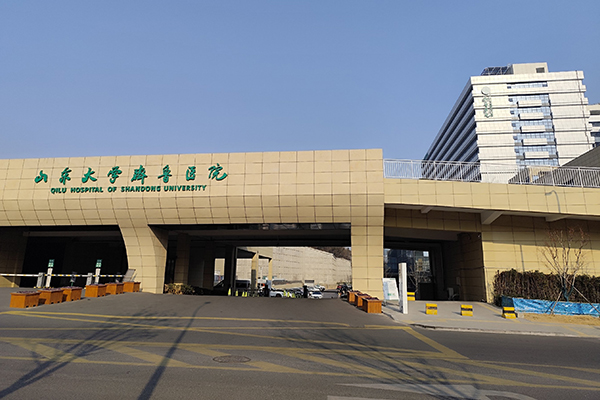
Qilu Hospital of Shandong University is a Grade A tertiary general hospital directly affiliated to the National Health Commission. It also serves as a directly affiliated hospital of Shandong University (a key university under the direct administration of the Ministry of Education), the First Clinical College of Shandong University, and the main construction unit for the first-class discipline of Clinical Medicine. Additionally, it is among the first batch of leading and main construction units for the co-constructed national regional medical centers by the National Health Commission and provincial governments, an output hospital for national regional medical center construction, and a construction unit for national medical centers.
Founded in 1890, the hospital has gone through several name changes, including Huamei Hospital, Gonghe Hospital, Qilu Hospital, and Affiliated Hospital of Shandong Medical University. In October 2000, it was officially renamed Qilu Hospital of Shandong University. Over the past 135 years since its establishment, the hospital has upheld the spirit of "Benefiting the Masses with Medical Skills and Pursuing Truth with Broad Knowledge" and followed the motto of "Upholding Virtue in Medical Practice and Striving for Excellence in Professional Skills". It has comprehensively promoted the integrated development of medical treatment, teaching, scientific research, disease prevention and hospital management, earning a high reputation both at home and abroad.
High-Quality Medical Service System
The hospital has built a high-standard medical service system with 4,000 authorized beds. In 2024, it recorded a total of 3.275 million outpatient and emergency visits, over 230,000 discharged patients, and more than 120,000 surgical operations. In March 2025, the hospital further improved its performance in the newly released national performance monitoring for tertiary public hospitals, achieving the top-tier A++ rating for three consecutive years. Its Case Mix Index (CMI), which reflects the hospital's capacity to admit patients with complex, acute and critical illnesses, reached 1.69. The hospital has continuously promoted the expansion of high-quality medical resources and their balanced regional distribution. Its hierarchical diagnosis and treatment cooperative units cover all 16 cities in Shandong Province. It has taken the lead in establishing 53 specialized alliances and piloting the construction of a referral service center, achieving remarkable results in regional medical resource sharing.
High-Quality Scientific Research System
The hospital has constructed an integrated, full-chain technological innovation system that connects basic research, clinical research and achievement transformation, with 45 scientific research platforms at or above the provincial and ministerial levels. In 2024, it secured 13 major national key scientific research projects and 142 projects funded by the National Natural Science Foundation of China, ranking among the top medical institutions nationwide. The hospital has won numerous prestigious awards, including the Second Class National Science and Technology Award (Natural Science), the Ho Leung Ho Lee Foundation Award for Scientific and Technological Innovation, the First Class Medical Science and Technology Award of the Chinese Medical Association, and the 17th China Youth Science and Technology Award.
High-Quality Education and Teaching System
The Clinical Medicine major of the hospital has been selected as a national "Double First-Class" construction discipline, ranked Grade A in the fifth round of discipline evaluations, and listed among the top 0.50‰ in the ESI global rankings. It holds the doctoral degree authorization for the first-level discipline of Clinical Medicine, covering all secondary disciplines. As one of the earliest institutions in China to carry out standardized residency training, the hospital is also among the first batch of 24 national demonstration bases for standardized residency training and the first batch of national pilot bases for standardized specialist training. It has built a domestically advanced clinical skills training center, establishing a full-process, full-cycle and full-chain clinical skills training management system, with an annual training volume of approximately 36,000 person-times.
High-Quality Discipline and Talent System
The hospital has 31 national key disciplines and national key clinical specialties (including construction projects), with its cluster of key specialties reaching the domestic first-class level. It is home to 35 person-times of national high-level talents including academicians of the Chinese Academy of Engineering, 45 experts enjoying special allowances from the State Council, and 266 person-times of provincial and ministerial-level talents. It also hosts a postdoctoral research workstation, with the cumulative number of recruited postdoctoral researchers exceeding 300.
High-Quality International Cooperation System
Focusing on the international frontier of scientific and technological development, the hospital has established cooperative relations with 78 medical colleges and universities worldwide, continuously expanding the space for academic exchanges. It has jointly built high-level international scientific research institutions with world-renowned institutions such as the Karolinska Institutet in Sweden and the University of Bergen in Norway, including the International Joint Laboratory for Acute and Critical Care Medicine and the China-Norway Brain Science Research Center. Actively implementing the "Belt and Road" Initiative, the hospital has set up a joint training center with SingHealth Group in Singapore, and provided technical assistance to medical institutions in five Central Asian countries and Gulf countries such as Oman.
High-Quality Operation and Management System
Adhering to the president responsibility system under the leadership of the Party committee, the hospital takes high-quality Party building as the guide for high-quality development. In recent years, in accordance with the overall philosophy of "Emancipating the Mind, Innovating for Change, Gathering Wisdom for Strength, and Developing in an Open Manner", the hospital has thoroughly implemented the five major development strategies of "Establishing the Hospital with Medical Services, Strengthening the Hospital with Disciplines, Revitalizing the Hospital with Talents, Governing the Hospital by Law, and Leading the Hospital with Party Building". In line with the requirements of "Three Transformations and Three Improvements", it has taken the innovation of the "three major collaborative management mechanisms" (medical management collaboration mechanism, operation management collaboration mechanism, and discipline construction collaboration mechanism) as the starting point to comprehensively enhance the modernization level of its governance system and governance capacity.
Committed to putting people's health at the center, taking high-quality development as the theme, and reform and innovation as the driving force, Qilu Hospital of Shandong University strives to build itself into a domestically leading and world-class clinical medicine highland, a training base for leading talents, and a highland for scientific research achievement transformation. It endeavors to create a "Qilu Model" for the high-quality development of public hospitals in the process of Chinese modernization.
