
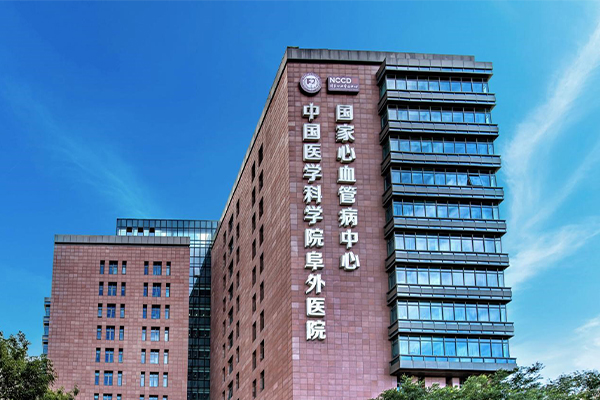
Founded in 1956, Fuwai Hospital, Chinese Academy of Medical Sciences, formerly known as the Thoracic Hospital of the Chinese People's Liberation Army, has evolved into a preeminent medical institution dedicated to cardiovascular care. In 2009, with the approval of the Central Organization Establishment Committee, the National Center for Cardiovascular Diseases (NCCD) was established, forming an integrated "Center-Hospital" operational structure. It stands as one of China's first national medical centers (guidance category), housing national-level resource platforms such as the State Key Laboratory of Cardiovascular Diseases and the National Clinical Research Center for Cardiovascular Diseases.
Over more than six decades, generations of Fuwai staff have fostered a profound sense of national commitment, inheriting the military culture of "obeying Party commands and being loyal to the Party" and the PUMC culture of "rigor, erudition, innovation, and dedication". Today, the hospital has grown into the world's largest center for cardiovascular disease diagnosis and treatment, as well as a national-level medical research and education hub integrating clinical care, education, research, and prevention.
In the new era, guided by Xi Jinping Thought on Socialism with Chinese Characteristics for a New Era, the hospital fully adheres to the requirements for the high-quality development of public hospitals. During the 14th Five-Year Plan period, it has defined two core goals: "striving to transform from a purely clinical center to a comprehensive medical center" and "endeavoring to shift the main battlefield of cardiovascular disease prevention and treatment from hospitals to communities". It has also established two strategic orientations: "building a domestically leading and internationally first-class innovative core base for cardiovascular medical care, prevention, research translation, and talent cultivation" and "developing a well-structured system led by cardiovascular disciplines with coordinated development of related fields, advancing the future transformation into a general hospital". The hospital is fully committed to opening up a new prospect in constructing a domestically leading and internationally first-class core base for cardiovascular medicine.
Medical Quality and Innovation
Covering an area of approximately 55,000 square meters, Fuwai Hospital is China's and the world's largest center for cardiovascular disease diagnosis and treatment. It features 41 wards with 1,403 open beds, 27 operating rooms, and 18 catheterization laboratories. Annually, it performs nearly 20,000 cardiovascular surgical procedures and over 50,000 cardiovascular interventional operations. For five consecutive years, it has ranked first nationwide in Case Mix Index (CMI) and also topped the performance assessment of national tertiary public hospitals (other specialized surgery groups).
Continuous Innovation in Diagnostic and Therapeutic Technologies
Over the past decade, the hospital has continuously addressed core technological bottlenecks through a series of groundbreaking innovations. These include the domestically independently developed third-generation fully magnetically levitated artificial heart, the world's first 3D-printed percutaneous inferior vena cava atrial septal defect occluder implantation, Asia's first percutaneous left ventricular assist device (Impella) application, the original Quantitative Flow Ratio (QFR) technology, interventional treatment for complex high-risk patients supported by the CorVAD percutaneous left ventricular assist device, the world's pioneering ultrasound-guided percutaneous interventional technology, and the independently developed MemoSorb®, the world's first absorbable occluder to be marketed. In the past five years, the hospital has launched 115 new clinical diagnostic and therapeutic technologies and projects, including 7 domestic first-time clinical applications and 13 global first-time clinical applications, filling technical gaps both domestically and internationally and leading the development of cardiovascular medical technologies.
Benchmark in Informatization Construction
Fuwai Hospital took the lead in China in developing a cardiovascular intelligent diagnosis and treatment platform centered on a fully structured electronic medical record with independent intellectual property rights. It is the first and only hospital in China to achieve Level 8 in electronic medical record application maturity and the first hospital in the country to attain Level 4 in the intelligent service grading assessment, supporting the high-quality development of public hospitals.
National-Level Research Base
The hospital currently hosts 2 national-level research platforms: the State Key Laboratory of Cardiovascular Diseases and the National Clinical Research Center for Cardiovascular Diseases, along with 4 provincial and ministerial-level laboratories such as the Key Laboratory of Regenerative Medicine for Cardiovascular Diseases of the National Health Commission. Focusing on researching the pathogenesis of cardiovascular diseases, identifying drug targets, developing key medical devices, and formulating clinical guidelines, it promotes medical innovation. Its research achievements have ranked first annually in the "STEM" (Cardiology and Cardiovascular Surgery) category for nine consecutive years. It has established the Global Cardiovascular Academic Prestige Evaluation (CAPE) platform and hosted the China Heart Congress for 20 consecutive years, leading the industry and driving the overall advancement of cardiovascular disease research nationwide.
Advancing Cardiovascular Disease Prevention and Treatment
Fuwai Hospital established China's first cardiovascular epidemiology research laboratory and pioneered the renowned "Shougang Model". Since the establishment of the National Center for Cardiovascular Diseases in 2009, it has implemented "Center-Hospital integration" and actively advocated "shifting the main battlefield of cardiovascular disease prevention and treatment from hospitals to communities". Over the past decade, leveraging four major programs such as the Early Screening and Comprehensive Intervention Project for High-Risk Groups of Cardiovascular Diseases and the National Primary Hypertension Prevention and Management Project, it has built a primary cardiovascular disease prevention and treatment network. It has promoted the deployment of high-quality medical resources to grassroots levels, becoming the first hospital in China to establish three national regional medical centers in Yunnan, Henan, and Shenzhen, setting benchmark models. It has continuously advanced the construction of the China Cardiovascular Technology Collaboration Network, assisting nearly 260 hospitals in 26 provinces and enhancing grassroots prevention and treatment capabilities.
Initiating and Promoting the National Healthy Lifestyle Campaign
The hospital has established China's first Healthy Lifestyle Medicine Center, integrating research on pathogenic risk factors with lifestyle studies, advocating "primary prevention" for chronic cardiovascular disease management, and contributing to the Healthy China initiative.
A Cradle for Talent Cultivation
Fuwai Hospital has nurtured 6 academicians of the Chinese Academy of Sciences and the Chinese Academy of Engineering, 28 experts with outstanding contributions at the national and provincial levels, and 83 recipients of government special allowances. Since 1970, it has trained approximately 1,000 cardiovascular professional and technical backbones annually for the country, including over 50 directors of cardiac departments. Around 60% of directors of cardiac centers in hospitals nationwide have received advanced training here. In the past five years, it has cultivated 1-2 national-level scientific and technological leaders such as recipients of the National Science Fund for Distinguished Young Scholars each year on average.
The hospital has been honored with numerous awards, including the title of National Civilized Unit, the National May 1st Labor Certificate, the National Youth Civilization, and the National Workers' Vanguard.
