
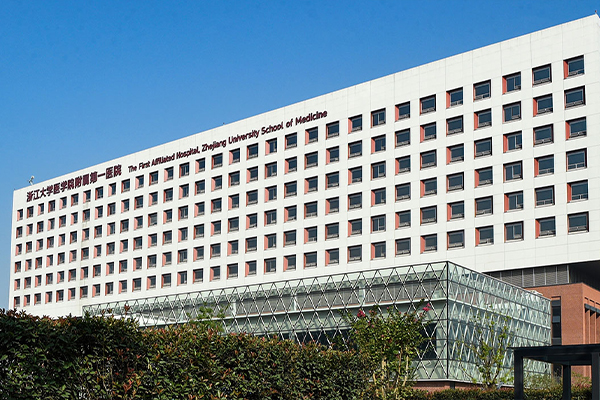
Founded in 1947, The First Affiliated Hospital, Zhejiang University School of Medicine is the first affiliated hospital established by Zhejiang University. Upholding the core spirit of "Preciseness and Truth-seeking", it enjoys a high reputation at home and abroad for its strong comprehensive strength, outstanding medical quality and distinctive disciplinary features. The hospital is a candidate institution for the National Medical Center, a pilot hospital for the high-quality development of national public hospitals, the National Medical Center for Infectious Diseases, a leading unit of the national regional medical center of the comprehensive category, a pilot hospital for establishing and improving the modern hospital management system, and a construction unit of the pilot project of the national flagship hospital for integrated traditional Chinese and Western medicine collaboration. It has successively won the national honors of "Two Excellence and One Advanced" (National Excellent Party Affairs Workers, National Excellent Communist Party Members, and National Advanced Primary-level Party Organizations), and the 9th Zhejiang Provincial People's Government Quality Award. The hospital has a multi-campus layout including Yuhang Campus (Phase I of the headquarters has been put into use, Phase II is under construction), Qingchun Campus, Zhijiang Campus, Chengzhan Campus, Zhejiang Provincial Public Health Clinical Center (under construction), Daxue Road Science and Education Base and Qiantang Innovation and Transformation Center. At present, it covers a total area of 519.3 mu, with 5,000 open beds and over 10,000 staff members.
Weathering Storms and Passing on the Torch
The hospital's predecessor, the Affiliated Hospital of the National Zhejiang University School of Medicine, was founded on November 1, 1947, under the personal initiative of Professor Zhu Kezhen, then President of Zhejiang University. Its first president was Professor Wang Jiwu, a renowned expert in internal medicine and infectious diseases in China. At the time of its establishment, the hospital had only 65 beds, 66 staff members and a floor area of 3.8 mu, earning it the nickname of the "Alley Hospital". The hospital changed its name several times in 1952 and 1960. In 1998, the former Zhejiang University, Zhejiang Medical University and other two universities merged to form the new Zhejiang University, marking the hospital's entry into a period of rapid development. It was officially renamed The First Affiliated Hospital, Zhejiang University School of Medicine (also known as Zhejiang Provincial First Hospital) in 1999. In December 2018, the hospital took the lead in implementing the president responsibility system under the leadership of the Party committee, ushering in a new journey of high-quality development guided by Party building.
Growing Comprehensive Strength
In March 2025, the National Health Commission released the 2023 performance evaluation results of national tertiary public hospitals. Among 1,588 participating tertiary public general hospitals, the hospital has been rated A++ for six consecutive years, ranking among the top 1% nationwide. In July 2024, the Chinese Academy of Medical Sciences released the 2023 China Hospital Science and Technology Evaluation Metrics (STEM). The hospital ranked 6th in the comprehensive national ranking, with 8 majors entering the top 10 nationwide. Both Infectious Diseases and Gastroenterology ranked 1st in the country, and its five-year cumulative STEM ranked 5th nationwide. It has a top-tier talent team led by high-caliber talents such as academicians and recipients of the National Science Fund for Distinguished Young Scholars. Currently, it has 2 national key disciplines and 28 national key clinical specialties (including 6 construction projects). Renowned in the fields of organ transplantation, infectious diseases, hematological diseases, kidney diseases, urinary system diseases and clinical pharmacy, it is one of the medical centers in China with the most comprehensive categories of major organ transplantation.
Collaborative Innovation in Medical Care, Teaching and Research
The hospital is equipped with 1 national key laboratory, 1 Basic Science Center of the National Natural Science Foundation of China, and 1 national clinical research center. It serves as a national major infectious disease treatment base and undertakes the construction task of the National Project for Improving the Diagnosis and Treatment Capacity of Difficult Diseases (in the direction of critical care medicine). It has successively won 1 Special-Class National Science and Technology Progress Award (the only one in the education and health system), 2 First-Class National Science and Technology Progress Awards and 9 Second-Class National Science and Technology Progress Awards. As one of the first national demonstration centers for clinical teaching and training, a national demonstration base for standardized residency training, one of the first national "Great Ideological and Political Course" practical teaching bases, and one of the first national training bases for basic surgical skills enhancement programs, it has 1 national-level teaching team, offers 2 national-level excellent resource sharing courses, 1 national-level excellent video open course and 4 national-level first-class courses, and has edited or co-edited 59 national-level planning textbooks. It ranked among the top 10 nationwide in the first national quality evaluation of clinical practice education in university-affiliated hospitals.
Strengthening Responsibilities Under the Guidance of Party Building
Taking the lead in implementing the president responsibility system under the leadership of the Party committee, the hospital has achieved in-depth integration of Party building and professional work, and full coverage of "double leaders" in both Party building and academic fields. For the first time, the national honors of "Two Excellence and One Advanced" (National Excellent Party Affairs Workers, National Excellent Communist Party Members and National Advanced Primary-level Party Organizations) have been awarded to the hospital, marking a milestone. Adhering to the decisions and arrangements of the Party Central Committee, the hospital always puts people and life first, and actively undertakes major tasks such as medical assistance to Africa, Qinghai and Xinjiang, COVID-19 treatment, medical support for the G20 Hangzhou Summit and the 19th Asian Games Hangzhou. It has been honored with titles such as the National Advanced Collective in the Fight against COVID-19 and the National Advanced Collective in COVID-19 Prevention and Control Work of the National Health System, and has been commended many times by the National Development and Reform Commission, the National Health Commission and other departments. Adhering to the public welfare nature of public hospitals, it has implemented the "Shan-Hai" Project, taken over the management of 14 hospitals, and established remote network connections with 206 hospitals and 349 community health service centers (township health centers) inside and outside the province, fully realizing the sinking of high-quality medical resources.
On the new journey of striving for the second centenary goal, The First Affiliated Hospital, Zhejiang University School of Medicine will always adhere to putting people and life first, uphold integrity and innovation, strengthen its mission and responsibility, actively serve the Healthy China strategy, continuously explore the "Zheyi Approach" for public hospital reform oriented towards public welfare, bravely shoulder its mission in improving the quality and efficiency of medical services, building top-tier disciplines, consolidating the foundation of teaching and nurturing talents, and innovating and enhancing the capacity of digital and intelligent management, accelerate the writing of a new chapter for the high-quality construction of the National Medical Center, and lay a solid health foundation for promoting the development of the health cause in the new era and building a great modern socialist country in all respects.
